Strategic sales and talent development
Welcome to our service page on strategic sales and talent development!
Do you want to optimize your sales department and sales leadership through a strategic approach?
Would you like to learn how to identify and develop your Challenger salespeople based on their talents?
Then you’ve come to the right place!
Read blog: Talentfokuseret salgsstrategi
We will explore the importance of strategic sales and how it can help you transform your sales department into a greater success.
We will also discuss how you can differentiate the development of your salespeople based on their unique talents.
So let’s dive into the topic and achieve the results you’re aiming for!
Seize the opportunity to transform your sales department into a greater success by focusing on strategic sales and talent development.
Sales results through strategic sales based on the Challenger process
Implementing a challenge-based approach, where the salesperson teaches to create differentiation, adapts to the customer’s needs, and takes control of the sale, is essential for strategically implementing Challenger sales.
By analyzing and understanding the customer’s needs, valuable solutions can be created through insightful conversations focused on challenging the customer’s status quo.
With the right skills in key account management and competencies in identifying the customer’s purchasing strategy, the Challenger approach can deliver positive results.
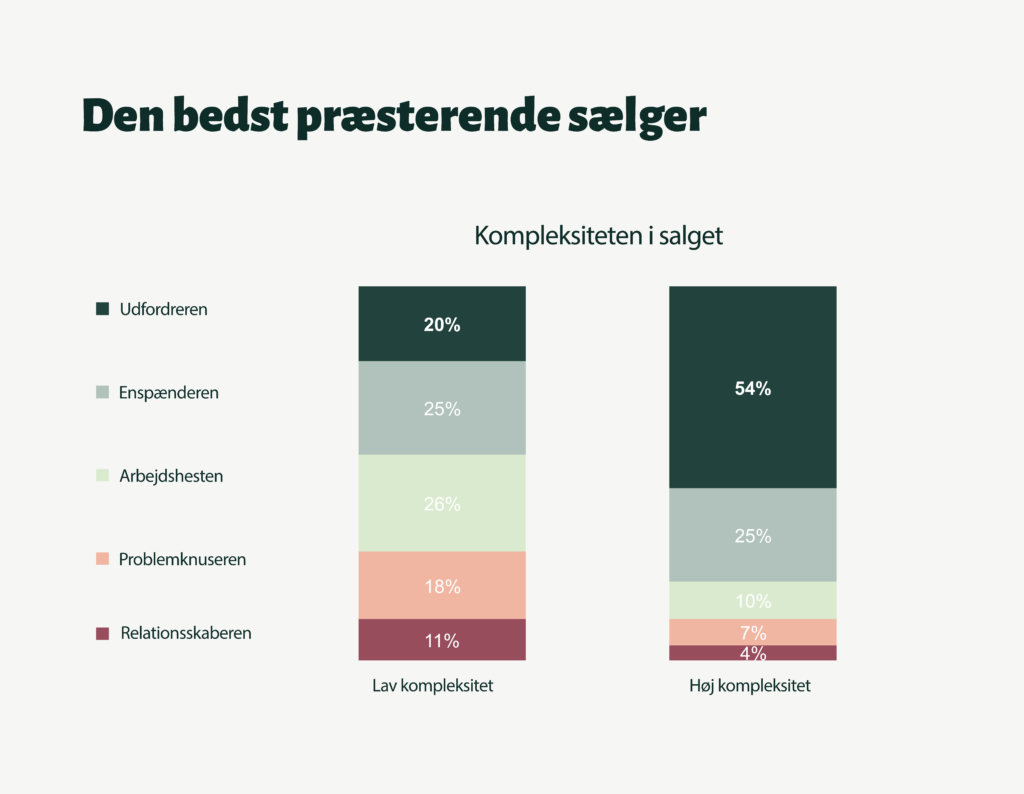
Figure: The Best-Performing Salesperson
The Challenger salesperson performs best among the five salesperson types:
- The Challenger
- The Relationship Builder
- The Hard Worker
- The Lone Wolf
- The Problem Solver
*High complexity is defined as the sale of diverse packages of products and solutions over longer sales cycles.
Source: Matthew Dixon & Brent Adamson: The Challenger Sale (2011)
The Relationship Builder plays a relatively small role, considering how often relationship selling is referred to as a sound sales methodology.
It is highly unlikely that the Relationship Builder will succeed in a sales process with high complexity.
The Challenger performs better than the Relationship Builder and the Problem Solver in a sales process of low complexity, and almost as well as the Hard Worker and the Lone Wolf.
The Challenger performs exceptionally well in a sales process with high complexity—better than the other four profiles combined.
Results Based on the Challenger Sales Process
In general, the Challenger sales model has shown a positive impact on:
Increased revenue and profitability:
The Challenger sales process has proven to increase revenue and profitability for companies.
By challenging the customer’s thinking, tailoring the messaging, and taking control of the sale, more value is created for the customer—practically resulting in larger purchases and higher profits.
Improved customer experience and loyalty:
With the Challenger sales process, companies can improve the customer experience by delivering insightful perspectives that change the way customers think about their business.
This leads to deeper resonance with the customer and increased loyalty to the company.
Strengthened competitiveness and market position:
Implementing the Challenger sales method gives companies a stronger competitive edge by challenging the customer’s status quo and adding value beyond the products or services they sell.
This helps build a differentiated brand image and positions the company more effectively in the market.
The Challenger salesperson
Using the TalentIndicator test, we can uncover the individual salesperson’s talents and place them in the context of the five salesperson types, where the Challenger salesperson type is crucial for having an effective sales strategy.
What potential is there to build on?
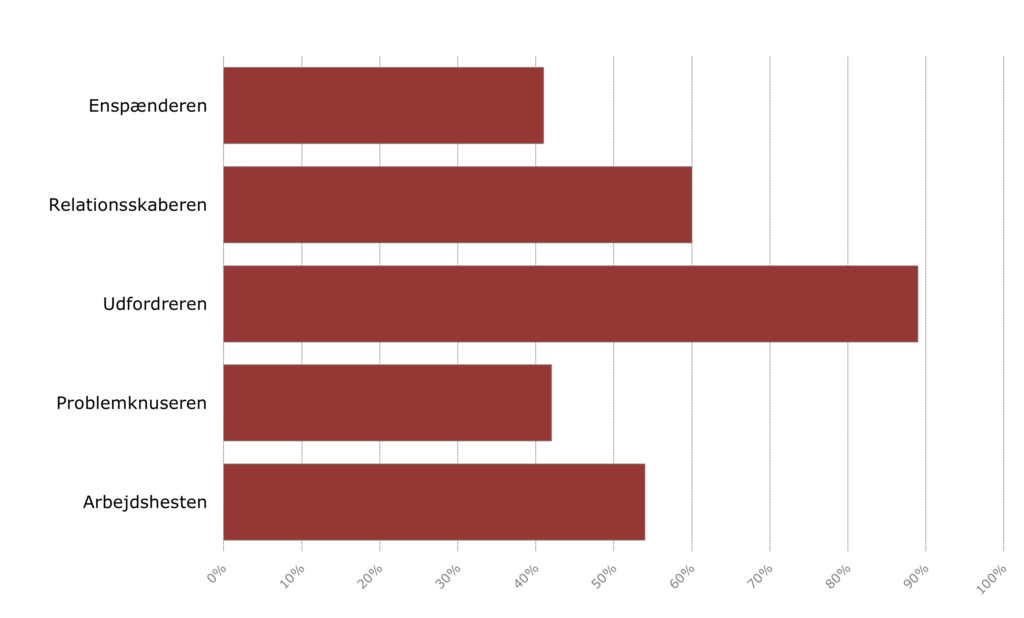
The Talent Indicator report shows in a graph the potential of the 5 salesperson types. We call the graph Challenger Sales Strengths.
As a starting point, the graph shows the potential for being a given salesperson type, based on their talent profile. The rule of thumb is that values well above 40% can be expected to perform above average 24/7/365 without breaking a sweat. If the value is around or below 40%, it can be expected that they will perform at a moderate level with challenges along the way. If the potential is 0 or just above, it can be expected that the talent profile will not perform even close to average.
Figure: Challenger Sales Strengths
Challenger Sales Strengths
Once the potential to become a Challenger salesperson has been identified, it becomes relevant to assess what development opportunities and plans can be made for each salesperson type to develop them toward becoming a Challenger. Or perhaps to develop a Challenger salesperson into an even better and more effective Challenger. In the Talent Indicator report, the third part of the Challenger dimension is a graph that illustrates development opportunities. We call the graph Talent Contribution to Challenger Sales Dimensions.
The graph provides an opportunity to assess which talents:
- Effectively support the role (Dark Pink),
- Moderately support the role (Light Pink),
- Challenge the role (White),
- Block the role (Gray),
for each salesperson type, with particular interest in the Challenger salesperson.
Figure: Talent Contribution to Challenger Sales Dimensions
In self-leadership, the graph can be used to assess how one can—or should—activate their own talents. Alternatively, in collaboration with sales leadership, it can be used to coach toward maximizing the use of talents in the context of the Challenger salesperson role. The coach and the individual salesperson can jointly select focus areas to optimize the management of talents across different parts of the sales process.
Development of the Challenger salesperson in everyday work.
As a salesperson in everyday work, it can be cumbersome to remember articulated strengths or development points. What is spoken lacks anchoring, where details and overall perspectives can be identified and the sought-after synergies can be turned into goals.
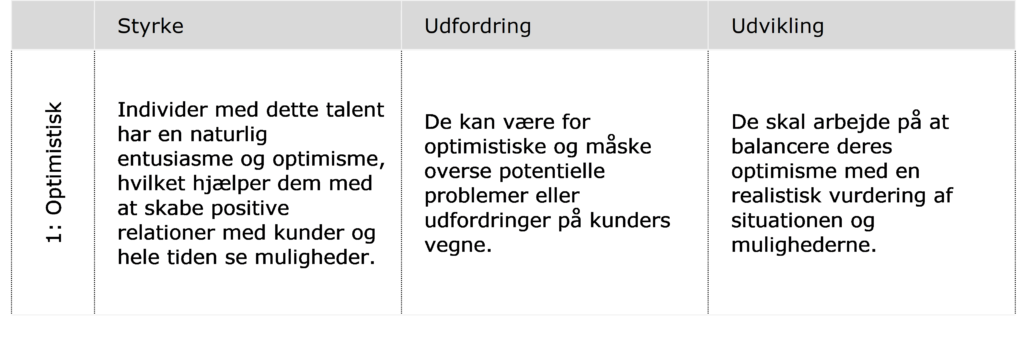
For that purpose, TalentInsights has developed a text-based support tool, where each top talent is assessed based on how they generally:
- Support (Strength),
- Challenge (Challenge),
- Can be developed on (Development),
in the role of Challenger salesperson:
Figur: Udviklings muligheder mod en bedre Udfordrer sælger
The development tool can be used by the individual salesperson, or together with a mentor/coach, to:
- Optimize the management of individual talents in the sales process, so talents are activated where they can and should be, and where they can contribute the most.
- Become aware of how or where they perhaps should not activate the talent in the Challenger sales process.
- Be agile and adaptable in the use of talent, so they do not blindly think in terms of strength and challenge, but reflect on how the talent could be managed in relation to the Challenger sales process.
A reflection that can provide development opportunities in the context of being a Challenger salesperson, to at minimum become better, but with the ultimate goal of leveraging the talent set’s potential to become a world-class Challenger salesperson.

Teach, Tailor & Take control
To master, succeed, and thrive as a Challenger salesperson, it is based on the idea that there are three parts of the sales process where the Challenger salesperson manages their talents to create value in each distinct phase.
For these three parts of the Challenger sales process, there are two illustrations that help assess:
- Potential
- Development points
The first illustration is Potential:
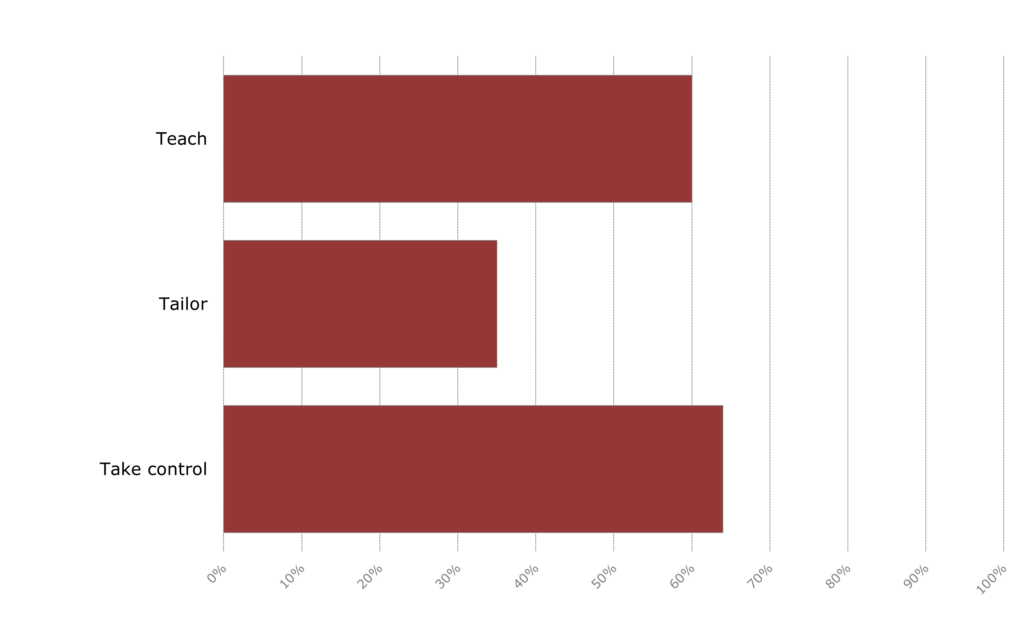
We call the illustration “Challenger TTT Strengths“
The three parts of the sales process are:
- Teach: Educate the customer
- Tailor: Customize the message
- Take Control: Take control of the sale
Together, they illustrate the potential within each of the three sales process phases.
Figure: Challenger TTT Strengths
The graph illustrates the potential for TTT.
As a general rule of thumb:
- Values significantly above 40% are expected to indicate the ability to perform above average consistently—day and night, year-round, without issues.
- Values around or below 40% suggest a more typical performance level, with some challenges likely to arise.
- Values close to 0% or only slightly above imply that the talent profile is unlikely to perform even at an average level.
What development opportunities are available?
Once the potential for TTT has been identified, it becomes relevant to evaluate the available opportunities for development and planning for each individual salesperson. The goal is to support their growth towards becoming a Challenger salesperson who masters TTT—or even to transform a Challenger into an even more skilled and effective version of themselves.
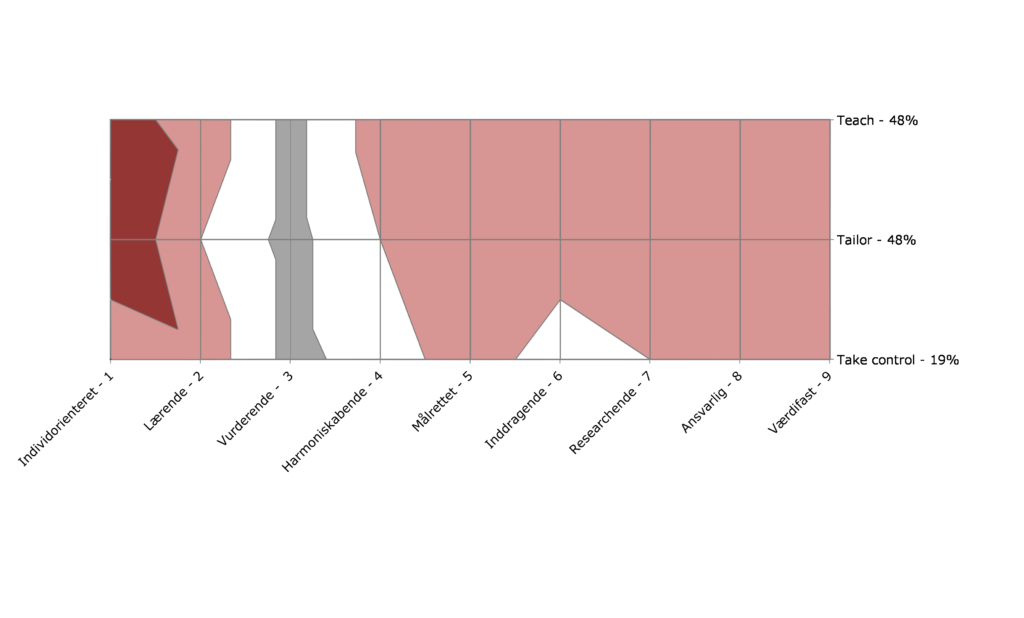
In the third section of the TalentIndicator report, within the TTT strength dimension, a graph illustrates the development opportunities. We refer to this as the “Talent Contribution to the Challenger TTT Dimension.”
The graph provides an overview of how different talents influence a salesperson’s use of TTT. It enables an assessment of which talents:
- Effectively support (Dark pink)
- Moderately support (Pink)
- Challenge (White)
- Block (Grey)
the individual salesperson’s ability to apply their talents in relation to TTT.
Figure: Talent contribution to Challenger TTT dimensions
The graph can be used as a tool for self-leadership, helping individuals assess how to best leverage their own talents. It can also be applied in collaboration with sales management for coaching purposes, aimed at maximizing the use of talents within the TTT sales process.
Together, the coach and the salesperson can identify key focus areas to optimize talent management across the different stages of the sales process.
Developing TTT in Everyday Sales Practice
Being a salesperson in the midst of daily routines can make it challenging to maintain a clear focus on well-defined strengths and areas for improvement. Verbal communication often lacks a stable foundation where both detailed insights and overarching themes can be recognized, and desired synergies translated into actionable goals.
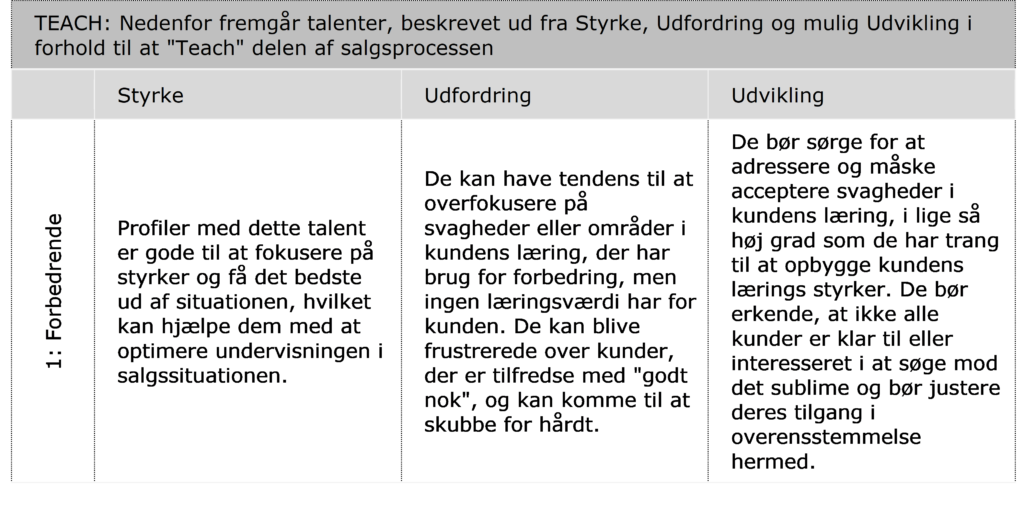
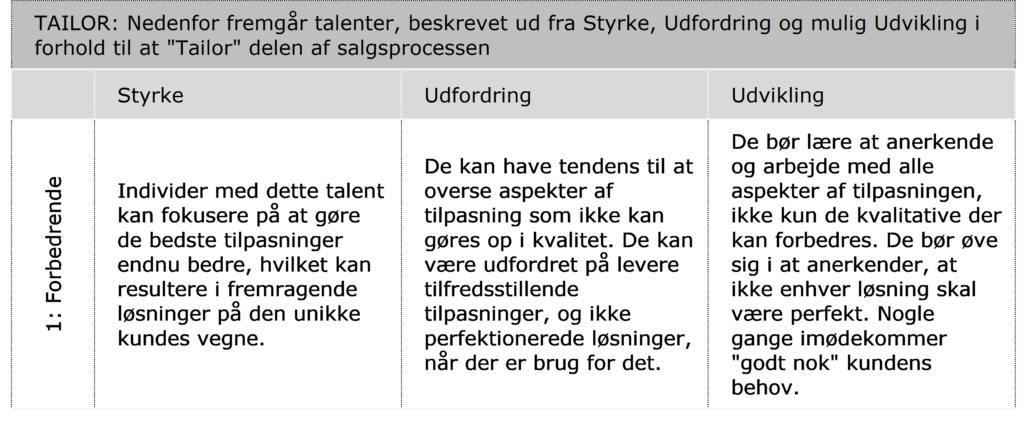
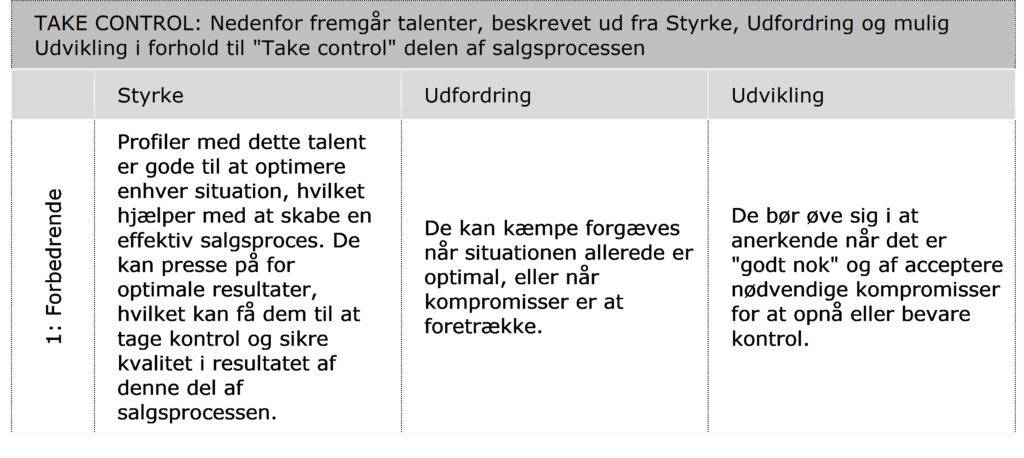
To address this, TalentInsights has created a written support tool that evaluates each top talent based on how it generally:
- Supports (Strength)
- Challenges (Challenge)
- Can be developed (Development)
within each of the three sales processes: Teach, Tailor, and Take Control.
The development tool can be used by individual salespeople or in collaboration with a mentor or coach, with the following objectives:
- To optimize the use of individual talents within the sales process, ensuring they are applied where they are most effective and can contribute the most.
- To raise awareness of where a talent may not be suitable within the Challenger sales approach.
- To develop agility and adaptability in talent usage, encouraging reflection beyond simple categories of strengths and challenges, and focusing instead on how each talent can be managed in relation to the Challenger sales process.
This reflective work opens up opportunities for growth, with the ultimate goal of becoming a better Challenger salesperson—and ultimately unlocking the full potential of one’s talents to become a world-class Challenger.
Summary – Why Contact TalentInsights?
Competitiveness
To improve your company’s competitiveness, it is essential to adopt a strategic approach to sales and talent development. By contacting TalentInsights, you gain access to their Challenger Development Framework, which is built on evidence-based methods and data analysis from thousands of salespeople around the world.
Challenger Development Framework
With TalentInsights’ Challenger Development Framework, you can identify and hire salespeople who possess the essential traits and skills to challenge customer thinking, tailor their messaging, and take control of the sales process.
By investing in talent-based development for your sales team, you foster a culture of learning and continuous improvement—where training, coaching, and feedback are highly prioritized.
TalentIndicator Strengths
TalentInsights offers targeted training and development programs that help your salespeople grow into Challengers and deliver greater value to your customers.
Their TalentIndicator assessment and profiles provide insights into your salespeople’s strengths and weaknesses, helping you identify areas where training and development are needed.
Strategic Sales and Talent Development
Remember, talent-based development of your salespeople is essential for achieving success in today’s competitive business environment. By implementing the Challenger Development Framework and prioritizing talent development, you can build a winning sales culture—one that meets customer needs and remains competitive in the long term.
Contact TalentInsights today and start strengthening your company’s competitive edge with their proven Challenger Development Framework.
Contact TalentInsights
Get in touch with TalentInsights today to learn more about how you can strengthen your company’s competitiveness through their Challenger Development Framework.
Their team of experts is ready to help you develop a successful strategy for strategic sales and talent development—giving you a competitive edge in the market.